There is a recurring pattern of metals that can be found in 1 Nephi, Nebuchadnezzar's dream, Moses's tabernacle, and Solomon's temple. This sequence of gold, silver, brass, and iron is used to symbolize the plan of salvation, the glory of God, and the balance of justice and mercy.
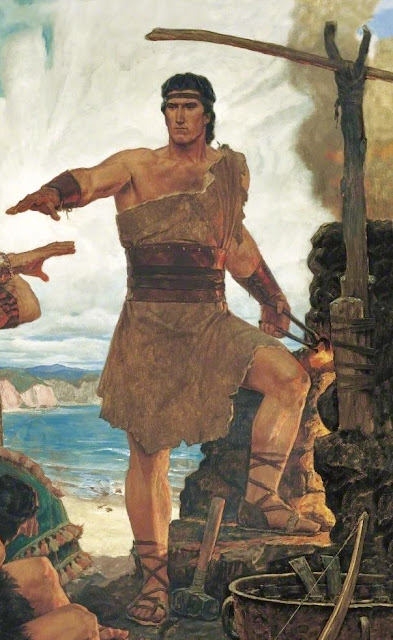
Arnold Friberg, Young Nephi Subdues His Rebellious Brothers (detail)

Nephi's interest in metals
“And I beheld his sword, and I drew it forth from the sheath thereof; and the hilt thereof was of pure gold, and the workmanship thereof was exceedingly fine, and I saw that the blade thereof was of the most precious steel.” [1]
Using his metallurgical skills, Nephi constructed a bellows and made molten tools in the wilderness. [2] He also rejoiced to find gold, silver, and copper ore in the promised land, [3] and he taught the art of metalwork to his followers. [4] So, why did Nephi say so much about metals in his record? Should it just be attributed to a personal interest? Or was Nephi trying to teach spiritual concepts through metallic symbolism? In his account, Nephi mentions four different types of metal: gold, silver, brass, and iron. These metals, and the sequence in which they are mentioned, matches a pattern in the Bible.
Terminology of metals in the scriptures
Before diving into the Biblical sequence of metals, I ought to make a brief explanation of scriptural terminology. The words “brass” and “steel” appear in both the King James Bible and the Book of Mormon, but there is some controversy surrounding them. As for brass, many translations of the Bible substitute the terms “bronze” or “copper” in an attempt to be historically accurate. There is no need to split hairs on this issue, however; brass and bronze have copper as the main component, so they aren’t that different in composition. For the sake of this article, brass, bronze, and copper will all be treated as synonyms.
Some people contend that steel did not exist in ancient times and is an anachronism in the Book of Mormon. We do not know if the steel mentioned in the scriptures is similar to modern steel, but we can be certain that the term is used to refer to an iron based compound. Steel and iron will be considered equivalent for the sake of this paper. For our purposes, we will group scriptural metals into the following four categories:
- Gold
- Silver
- Brass/Bronze/Copper
- Iron/Steel
Pattern of metals in the Bible
So, where do these four types of metal appear in the Bible? You’ve probably guessed it already: Nebuchadnezzar’s dream. If you recall, Nebuchadnezzar, king of Babylon, had a vision in which he saw a statue with the following makeup:
- Head of gold
- Breast and arms of silver
- Belly and thighs of brass
- Legs of iron
- Feet of iron mixed with clay
Daniel interpreted the statue as a representation of the kingdoms of the earth: Babylon is the golden head, followed by a succession of kingdoms down to the feet. The metals decrease in value moving down the statue, suggesting that the Babylonian “golden age” will be unrivaled by future kingdoms. Basically, the metallic sequence represents decreasing degrees of glory. This symbolic motif is found in other parts of the Bible as well and carries similar implications.
Were else can we find this metallic sequence in scripture? It actually appears in Moses’s tabernacle and Solomon’s temple. Both structures used the metal of highest value, gold, to decorate the most holy places, followed by silver, followed by brass. [5] Iron was not used in either structure, and iron tools were not even allowed on the construction site of Solomon’s temple! [6] Some have offered the explanation that iron was disallowed because, as the metal used for weapons, it was unfit for a holy place. [7] Why would these sacred buildings make use of three different metals instead of going for a more uniform design? The answer is that those who entered these edifices were meant to pass from one level of glory to another until they entered the presence of God within the Holy of Holies. It is also helpful to note that the metals did not just progress in value approaching the Holy of Holies; they also advanced in incorruptibility. Gold is the least corruptible of metals: it doesn’t oxidize or corrode, and it is one of the longest-lasting elements known to man. In this way, it is a fitting symbol for God’s glory; God, like gold, is eternal and unchanging. Silver is also a “noble metal” meaning that it is resistant to change. Copper and iron, on the other hand, are susceptible to change, as anyone who has seen a tarnished penny or a rusty nail knows. Given this pattern, an entrant to the temple/tabernacle is symbolically leaving the corruptible world of sin (represented by iron and copper) and entering, by degrees, into an eternal, incorruptible sphere (represented by gold and silver).
Applying alchemy to the scriptures
As interesting as this metallic symbolism is, I found that applying the principles of alchemy adds a new layer of meaning. Alchemy is a mystical precursor to modern chemistry, and it assigns spiritual meanings to the elements. According to alchemical symbolism, each metal is associated with a heavenly body (i.e. the sun, moon, and planets). Below, I have shown the heavenly bodies associated with the four metals discussed in this paper:
Gold-Sun (☉)
Silver-Moon (☽)
Copper-Venus (♀︎)
Iron-Mars (♂︎)
The first interesting connection is that the relative brightness of each heavenly body corresponds perfectly with the Biblical metallic sequence: Gold is associated with the brightest heavenly body, silver with the second brightest, and so on. In this way, the sequence of gold, silver, copper, and iron can suggest levels of spiritual light. This is actually quite similar to the doctrine of the Kingdoms of Glory:
Gold-Sun (☉) → Celestial Kingdom
Silver-Moon (☽) → Terrestrial Kingdom
Copper-Venus (♀︎) → Telestial Kingdom
Iron-Mars (♂︎) → Fallen world
One can see how the gold-silver-brass pattern of ancient temples fits the sun-moon-stars motif seen in modern temples. Associating Venus with the stars might not seem intuitive, but Venus is sometimes referred to as “the morning and evening star.” As the brightest object in the sky after the sun and moon, Venus can be considered the chief “star” and, hence, a representative of all the other stars. There is also a connection between Mars and the fallen world: the planet Mars is named for the Roman god of war, and the metal associated with Mars, iron, is used to make weapons. War and conflict only exist in a fallen world, so it is fitting to represent our mortal sphere with militaristic symbols.
So how old is the tradition of associating metals with the heavenly bodies? Would the ancient Hebrews have seen a connection between the sun, moon, and stars and the metals used in their temple? Actually, there is an indication that they may have. The Hebrew word for gold, “zihab,” also means “light.” It is therefore logical to suppose that they would have associated gold with the ultimate source of light: the sun. [8]
So how old is the tradition of associating metals with the heavenly bodies? Would the ancient Hebrews have seen a connection between the sun, moon, and stars and the metals used in their temple? Actually, there is an indication that they may have. The Hebrew word for gold, “zihab,” also means “light.” It is therefore logical to suppose that they would have associated gold with the ultimate source of light: the sun. [8]
There is another aspect of the planet/metal associations that adds to the symbolism of the temple. In alchemical tradition, each heavenly body has a gender: the sun and Mars are masculine, and the moon and Venus are feminine (Mars and Venus are considered archetypes of male and female, which is why we still use their alchemical symbols to designate male and female). Many dualities are suggested by these male-female pairings including the balance of justice and mercy. [9] Another interpretation is that there is a Divine male-female pair, represented by the incorruptible metals, gold and silver, and there is a mortal male-female pair, represented by the corruptible metals, iron and copper. This may imply that mortal men and women can progress to become gods and goddesses, or that there is a duality of the sexes in both the mortal and immortal realm.
Metals in 1 Nephi
You are probably wondering at this point: What does all of this have to do with Nephi and the Book of Mormon? The reason that I have explained the metallic sequence of gold-silver-brass-iron is that it appears in 1 Nephi. If you start at the beginning of the Book of Mormon and note the first mention of each type of metal, you get the following:
- Lehi leaves his gold and silver and departs into the wilderness (1 Nephi 2:4)
- Nephi and his brothers return to Jerusalem for the brass plates (1 Nephi 3:3)
- Nephi obtains Laban’s steel (iron) sword (1 Nephi 4:9)
- Lehi sees the iron rod in a vision (1 Nephi 8:19)
What could be the implication of the descending sequence of metals at the opening of Nephi’s record? Perhaps we are being shown Lehi and his family’s metaphorical descent. Lehi’s departure from Jerusalem into the wilderness represents man’s descent from the presence of God to mortality. It follows that Lehi’s sojourn in the wilderness represents mortal life, and that his arrival in the promised land represents his ascent to the Celestial Kingdom.
If the Book of Mormon starts with a descending pattern of metals, is the symbolism completed with an ascent? Yes, but the pattern is less clear. If we focus on the objects acquired by Lehi after his vision we arrive at the following:
- Lehi discovers a brass ball (the Liahona) (1 Nephi 16:10)
- Gold and silver are discovered in the promised land (1 Nephi 18:25)
As I mentioned, the list above focuses on objects obtained by Lehi, which excludes breaks in the pattern, like Nephi’s steel bow. This may amount to hand-waiving on my part, but regardless, there is a discernible “metallic chiasmus” that runs through 1 Nephi. In general, gold and silver serve as “book ends” in Jerusalem and the promised land, and the objects in the wilderness are composed of base metals (iron & copper). In this way, the metals in 1 Nephi symbolize a descent into mortality followed by an ascent into exaltation. This pattern of descension and ascension parallels the modern temple narrative. In the Endowment, we are shown mankind’s fall from God’s presence followed by their redemption and eventual return.
There are just a few more metallic patterns that can be teased out of 1 Nephi. The first that I will address is the brass objects. These objects include the brass plates, the Liahona, and Moses’s brass serpent. [10] All of these objects have a common theme: God’s merciful preservation. The brass plates preserve the religion, language, and culture of the Nephites, the Liahona provides temporal preservation by guiding Lehi’s family in the “most fertile parts of the wilderness,” [11] and the brass serpent preserves the life of those who looked upon it. The merciful theme of these brass objects fits the pattern of copper/female/mercy.
Running parallel to the brass/copper theme is (not surprisingly) a steel/iron theme. The steel and iron objects in 1 Nephi are Laban’s sword, Nephi’s bow, and the iron rod. We know that the iron rod of Lehi’s vision represents the word of God, but how is it connected with the bow and sword? There are several places in the scriptures where God’s word is compared to a weapon, particularly a sword. [12] God’s word is weapon-like because it is used to defend the innocent and condemn the wicked. The word of God is therefore associated with justice, and justice, like iron, has masculine connotations. If Laban’s sword represents God’s word, that may be why it has a gold hilt: God is associated with gold, and the sword represents His justice. One final note on iron: it is significant that, in Lehi’s dream, an iron rod lead through the “dark and dreary waste” to the tree of life. Iron is associated with the fallen world and exists outside of the “sacred space” that is the tree of life. The rod, being iron, represents the first step in a spiritual ascent toward God’s presence (the tree).
The process of transmutation
In conclusion, there is a symbolic hierarchy of metals in the scriptures, and it is used to represent a progression from the mortal, fallen world to God’s eternal dwelling place. The pattern of iron-copper-silver-gold represents progression in material worth, incorruptibility, and light. Genders traditionally ascribed to these metals reflect a duality of the sexes as well as the balance of justice and mercy. All of these themes run throughout the Bible, the Book of Mormon, and alchemical traditions. However, the most important aspect of alchemy is not metal symbolism; the central theme of alchemy is the transmutation of base metals into precious metals. The classic example of this is turning lead into gold, but alchemical transmutation also applies to iron and copper (base metals), and silver (a precious metal). The idea of transforming one metal into another seems foolish in our day, but it should be noted that the alchemists saw their work as a spiritual metaphor. Like base metals, the alchemists believed that the soul of man could be refined, purified, and eventually transmuted into something divine. In that sense, the pairing of base and precious metals is a symbol for the ultimate transmutation: the redemption of the soul and the resurrection of the body. This may be the intended message of the metallic sequence in the scriptures: We don’t have to be tarnished by the world. We don’t have to be deteriorated by the struggles of mortality. God can transform us into something incorruptible, eternal, and beautiful. Of all the materials on this earth, gold may represent our Heavenly Father the best. In a world of decay, it remains unchanged. It’s luster and purity endure while civilizations rise and fall. In that way, it is like the most immutable of heavenly bodies: the sun. Day after day, the sun’s brightness is never diminished, and no human activity can alter it’s course or delay it’s rising. Both of these symbols, gold and the sun, only hint at the incomprehensible immutability of the Father:
“For do we not read that God is the same yesterday, today, and forever, and in him there is no variableness neither shadow of changing?” [13]
Further Reading:
For more information on the male/female duality of justice and mercy, the symbolism of the sun and moon, and the Word of God as a weapon, see my blog post: Dualistic Symbols in the Book of Mormon and LDS Temple Endowment. (http://turnnotaside.blogspot.com/2018/06/symbols-of-duality-representing-sacred.html)For a deeper analysis of the symbolic meaning of the Liahona and Sword of Laban, see my blog post: Symbolism of the Sword of Laban, the Brass Plates, and the Liahona. (http://turnnotaside.blogspot.com/2018/06/symbolism-of-sword-of-laban-brass.html)
End Notes:
[1] 1 Nephi 4:9
[2] 1 Nephi 17:9-11
[3] 1 Nephi 18:25
[4] 2 Nephi 5:15
[5] Prager, Dennis. The Rational Bible: Exodus. Regnery Faith, 2018, pp. 368-369
For Solomon’s temple, see 1 Kings 7:15-27, 38, 1 Chronicles 29:4, 2 Chronicles 3:4-10, 2 Chronicles 4:1-7
[6] 1 Kings 6:7
[7] Prager, p. 369
[8] Pike, Albert. Morals and Dogma of the Ancient and Accepted Scottish Rite of Freemasonry. Charleston A.’.M.’. 5632, 1871, p. 58
[9] see Alma 42:24
[10] 1 Nephi 17:41
[11] 1 Nephi 16:14
[12] See D&C 6:2 & Isaiah 11:14
[13] Mormon 9:9

